
Kazakhstan Travel Tips for Indians: Money, SIM, Food and Etiquette
The practical layer nobody covers: which network works in the mountains, what vegetarians actually eat, and the document rule that ends day trips.
By SYT Editorial, Travel Content Team ·
- Exchange rate (14 September 2026)
- 1 Kazakh tenge = about Rs 0.21
- Almaty metro fare
- 120 tenge per ride with an Onay card
- Onay transport card
- 500 tenge, of which 420 tenge is a refundable deposit
- Visa-free stay for Indian passport holders
- 14 continuous days per entry
- Almaty average January temperature
- -8.1C to 0.5C
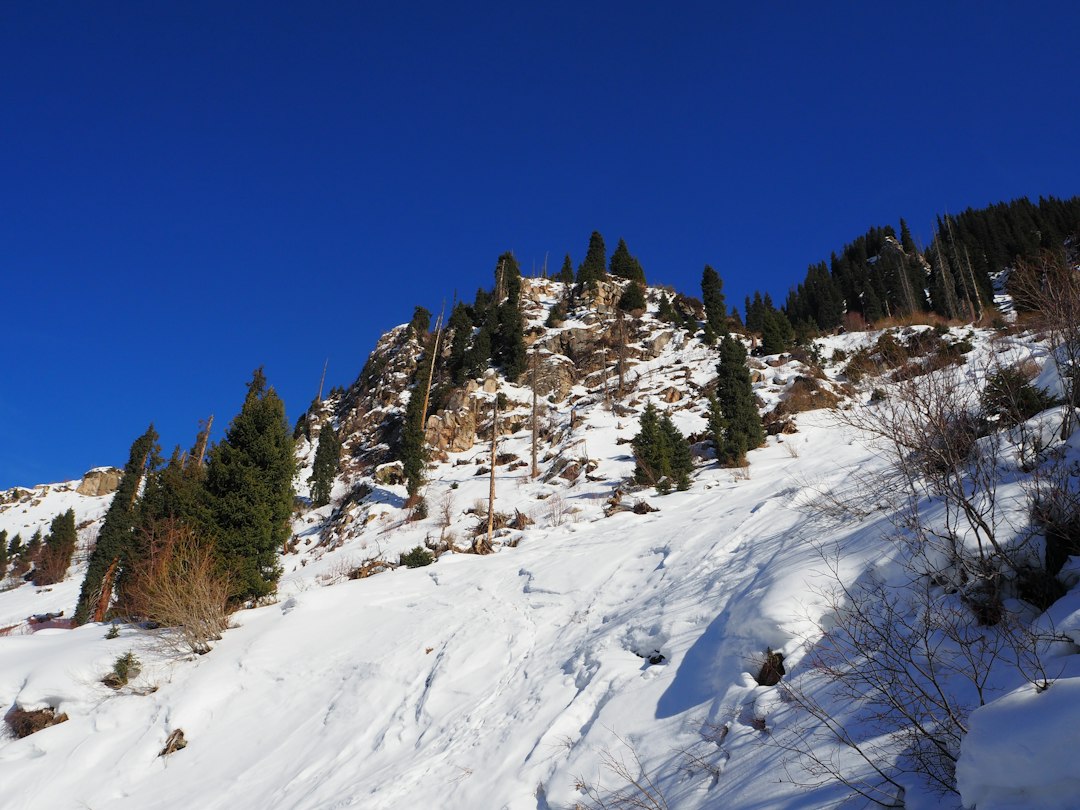
Photo by Bagzhan Sadvakassov
This is the layer that decides whether a Kazakhstan trip runs smoothly, and almost none of it appears in the itinerary articles.
Money: learn one number
The currency is the tenge (KZT). As of 14 September 2026, 1 tenge was worth about Rs 0.21. Divide tenge by five for a working rupee figure. A 1,000 tenge lunch is about Rs 210. A 120 tenge metro ride is about Rs 26.
Cards work well in Almaty. Restaurants, hotels, supermarkets and larger shops all take them, and contactless is normal.
Cash matters exactly where your itinerary goes. The Green Bazaar, national park gates at Charyn, Kolsai, Kaindy, Ayusai and Issyk, rural cafes, and small mountain stops are all cash-first. Every one of those is a day-trip stop. Carry tenge in notes before you leave the city, because there is no ATM at a canyon rim.
Change money in the city at exchange offices rather than at the airport, and do not expect Indian rupees to be widely exchangeable. Carry US dollars or use a card at an ATM.
SIM and data: pick the network for where you are going
Kazakhstan has three main networks: Kcell, Beeline and Tele2. Kcell and Beeline each hold around 40% of subscribers.
The useful distinction for a traveller: Kcell has the widest overall coverage and is what most international eSIM providers ride on, but Beeline is reported as stronger in the Almaty mountain region, specifically around Shymbulak and Big Almaty Lake.
Since that mountain region is where you will spend half your trip, this matters more than it sounds. If you are buying a physical SIM in Almaty and your plan is mountain-heavy, Beeline is worth considering. If you want the simplest option, an eSIM installed before you fly, on Kcell or Tele2, is faster to set up and works everywhere the roads are sealed.
Either way, download offline maps for the Charyn, Kolsai and Kaindy areas. Signal is patchy for most of those drives regardless of network.
Food: vegetarians should plan, not worry
Kazakh cuisine is built on meat. Beshbarmak, the national dish, is boiled meat with noodles. Horse meat and mutton are staples, and kumis, fermented mare's milk, is offered as hospitality.
That said, Almaty is genuinely easy. It has a real cafe and restaurant scene, international food, large supermarkets, and Indian restaurants. Vegetarians and vegans do best in coffee shops, international restaurants and supermarkets, where fruit, bread, nuts and dairy-free basics are simple to assemble.
Where it gets harder is exactly where the itinerary takes you: mountain stops, park gates and rural cafes with two things on the menu, both of them meat. Carry snacks on day-trip days. This is not a hardship, it is a packing decision.
Two practical notes. Bread, dairy, salads and plov made without meat are usually findable. And vegetarian in the Indian sense often needs explaining, since "no meat" locally may not exclude stock, so learn the phrase or keep a translated note on your phone.
Language: Kazakh, Russian and not much English
Kazakh and Russian are both in daily use, and Russian is the lingua franca in Almaty. English is limited outside hotels, tour operators and the newer cafes.
This is less of a problem than it sounds because translation apps work well, but download the Russian offline pack before you go, since the places with the worst English also have the worst signal.
Museum and zoo signage is mostly Kazakh and Russian. If you want the history explained, a guide is worth the money in a way it is not in more English-friendly destinations.
The document rule that ends day trips
The single most important practical fact in this article: carry your original passport on day trips.
Kolsai, Kaindy and the road above Big Almaty Lake all sit inside border-zone control areas. There is a checkpoint before Saty village. Photocopies are refused and travellers are turned back. People lose a fourteen-hour day at the halfway point over this.
Your visa-free entitlement as an Indian passport holder is 14 days per entry, and keeping the entry stamp with you is sensible for the same reason.
Getting around the city
An Onay card covers the metro, buses and trolleybuses. It costs 500 tenge, of which 420 tenge is a refundable deposit, and rides are 120 tenge. The metro is small, a single line, but the bus network is extensive and the card is what makes it usable.
Ride-hailing apps work well in Almaty and are the default for most visitors. They are cheap by Indian standards for the distances involved.
Etiquette, briefly
Kazakhstan is a secular country with a Muslim majority and a strong Russian-influenced urban culture. Almaty dresses and behaves like a modern city.
- Hospitality is taken seriously. If you are offered tea, kumis or dried curd, accepting even a token amount matters.
- Remove shoes when entering a home or a yurt.
- Cover shoulders, knees and, for women, hair inside working churches and mosques. Zenkov Cathedral is an active church, not a museum.
- Ask before photographing people, particularly at the bazaar and at religious sites.
- Tipping is not obligatory but rounding up is normal in restaurants.
Weather, and the one packing rule
Almaty runs from a January average of -8.1C to 0.5C to a July average of 18.6C to 30.5C. Whatever the season, the mountains are 10 to 15 degrees colder than the city, and the mountains are where you are going.
So the packing rule is the same all year: pack for the city, then add a proper jacket for the mountains. In summer people get this wrong most often, because 30C in Almaty does not feel like it needs a fleece until you are standing at 3,163 metres.
The five things I would tell a first-timer
- Carry your original passport on every day trip.
- Carry cash in tenge, even though cards work in the city.
- Get a local eSIM, and download offline maps and the Russian language pack.
- Pack a jacket regardless of the month.
- Carry snacks on the long day-trip days if you are vegetarian.
Questions people ask
Is Kazakhstan good for vegetarians?
Almaty is genuinely easy, with a real cafe scene, international restaurants, supermarkets and Indian food. The difficulty is on day trips, where mountain stops and park cafes often have only meat dishes. Carry snacks on those days and you will be fine.
Which SIM card is best in Kazakhstan?
Kcell has the widest overall coverage and is what most international eSIMs use. Beeline is reported as stronger in the Almaty mountain region around Shymbulak and Big Almaty Lake, which is where much of a typical itinerary goes.
Do cards work in Kazakhstan or do I need cash?
Both. Cards are widely accepted in Almaty restaurants, hotels and shops. Cash in tenge is needed at the Green Bazaar, national park gates and rural stops, which are exactly where day trips take you. There is no ATM at a canyon rim.
Is English spoken in Kazakhstan?
Limited outside hotels, tour operators and newer cafes. Russian is the working language in Almaty, with Kazakh alongside it. Download an offline Russian translation pack, because the places with the least English also have the weakest mobile signal.
What is the most important practical rule for day trips?
Carry your original passport. Kolsai, Kaindy and the road above Big Almaty Lake are inside border-control zones, and the checkpoint before Saty village refuses photocopies. People are turned back halfway through a fourteen-hour day over this.
How much is public transport in Almaty?
120 tenge a ride, about Rs 26, paid with an Onay card. The card costs 500 tenge, of which 420 tenge is a refundable deposit, and it works on the metro, buses and trolleybuses.
What should I wear in Kazakhstan?
City clothes plus a proper jacket, in every season. Almaty averages a 30.5C high in July and below freezing in January, but the mountains run 10 to 15 degrees colder than the city year round. Inside working churches, cover shoulders and knees.
Can I exchange Indian rupees in Kazakhstan?
Do not count on it. Rupees are not widely exchangeable. Carry US dollars to change at city exchange offices, or withdraw tenge from an ATM with a card, and avoid changing money at the airport where rates are worse.
Sources
- Kazakhstani tenge to Indian rupees Exchange Rate History · Wise
- Buying a SIM Card or eSIM for Travel in Kazakhstan (2026 Guide) · Too Many Adapters
- Almaty Metro: 11 stations, 13.4 km, fares and map · Mapa Metro
- Onay card - check balance, top up and buy · Almaty Metro
- Kazakhstan Introduced Visa Free Travel for Citizens of India for up to 14 days · Embassy of India, Astana
- Almaty climate: seasons, monthly averages · Climates to Travel
Written by
SYT Editorial
Travel Content Team
All guides by SYT →02More from Kazakhstan
- 01Best Time to Visit Kazakhstan: Month by Month Weather Guide6 min
- 02Where to Stay in Kazakhstan: Areas Honestly Compared6 min
- 03Kazakhstan Visa for Indians: Rules, Fees and How to Apply6 min
- 04Kazakhstan Trip from India: The Complete Planning Guide5 min
- 05Kazakhstan Trip Cost from India: A Real Budget Breakdown5 min
- 067-Day Kazakhstan Itinerary6 min
03Popular packages
See all →
Want this Kazakhstan trip planned end to end?
Send your dates and group - a specialist replies with a day-by-day plan and a price.